A Windows IRC client written in Delphi 4, started on December 3, 1998 — my first day with the language. This repository is preserved as a historical artifact from the late-90s IRC scene. It is not maintained, and nobody is expected to run it on a modern system.
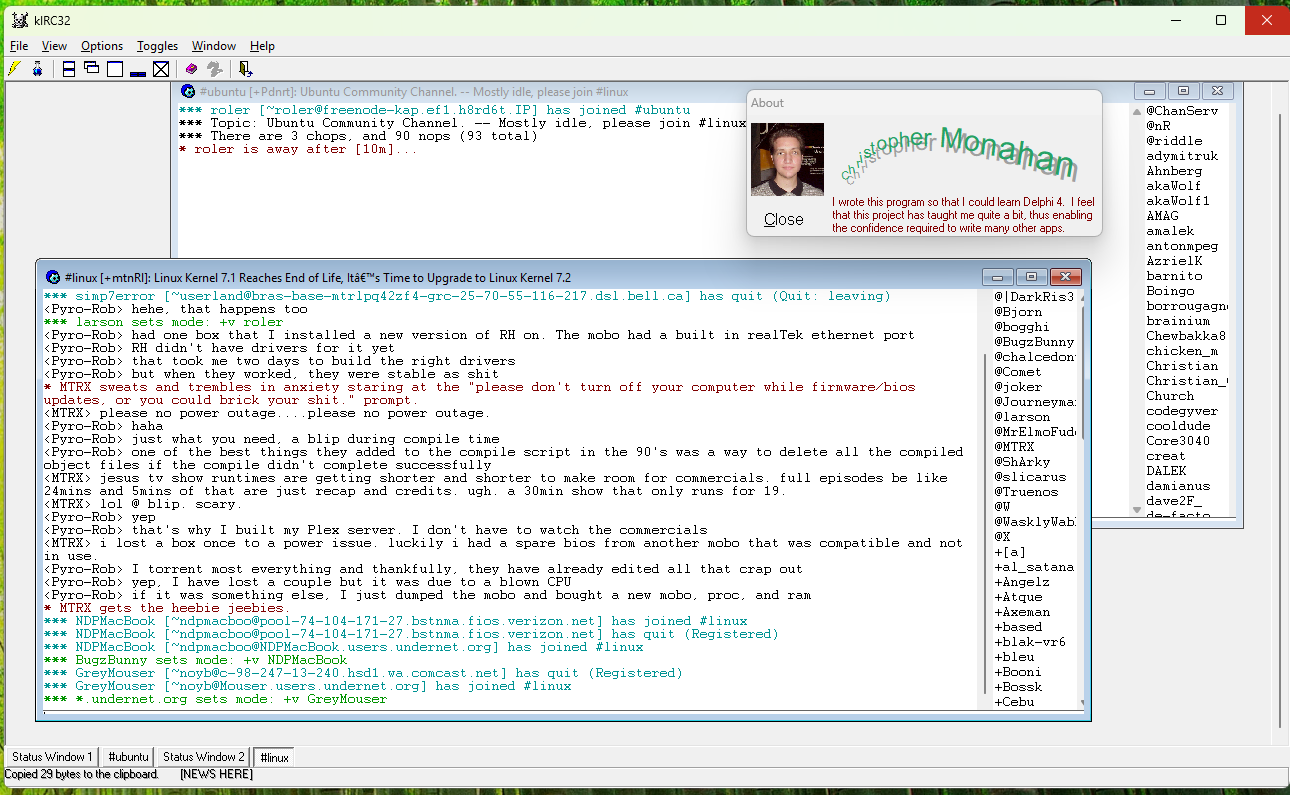
I wrote this program so that I could learn Delphi 4. I feel that this project has taught me quite a bit, thus enabling the confidence required to write many other apps.
That note from the About box still sums it up: kIRC was a learning project that grew into a full MDI client with channels, queries, DCC, color codes, and a long wish list of mIRC-inspired features.
kIRC32 with channel windows, nick lists, window tabs, and the About dialog:
At the time, IRC was how a lot of people lived online — Undernet, DALnet, and friends in #linux and #ubuntu-style channels. Desktop clients were MDI Windows apps with toolbars, status bars, and a /command culture borrowed heavily from mIRC.
kIRC aimed at that world:
- Multiple server and channel windows with a tab bar
- Nickname completion,
/umode,/server,/ame, and a growing command set - mIRC color code support
- DCC send/receive
- WHOIS wrapper, aliases (started), and server list management
The bundled binary in this tree is from that era (Project1.exe). Source is classic Delphi: .pas / .dfm forms for the main client, status, channels, DCC, settings, and more.
| Version | Date | Notes |
|---|---|---|
| Started | 12/3/98 | First day in Delphi |
| v0.5 Beta | 12/20/98 | Very primitive, but stable |
| v0.7 Beta | 2/11/99 | Nick completion, DCC, TabBar, mIRC colors, more commands |
| Source in repo | — | Reports as v0.8 |
The original README was mostly a living changelog and an enormous TODO list (ANSI colors, scripting, notify/ignore lists, flood protection, popup editor, and plenty of “tomorrow” ideas). That energy is part of the history — a teenager (or thereabouts) reverse-engineering how “real” IRC clients felt by building one.
This code is shared for nostalgia and archaeology, not as software you should depend on today.