An Android companion app for learning Japanese with Aiko—locally deployed, privacy-first.
Aiko-Lingo is a native Kotlin/Jetpack Compose application that connects to your local Aiko-chan AI server over Tailscale, providing interactive Japanese language learning through JLPT-tracked vocab decks, grammar decks, review sessions, typing practice, guided conversation, and real-time translation. The app exists as a dedicated frontend precisely because language learning requires a distinct interaction model from general-purpose chat.
Author: OppaAI · Beautiful British Columbia, Canada



Frontend:


Backend:






Click the thumbnail below to watch on YouTube ▶
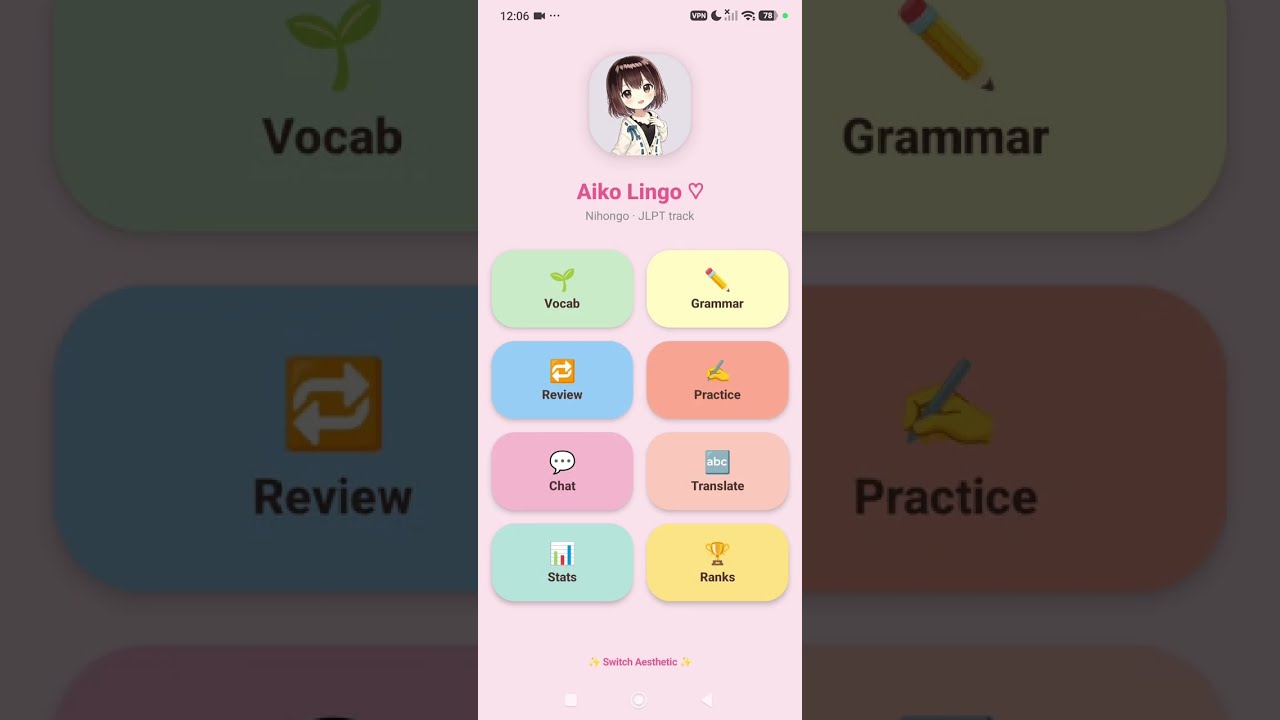
- Vocab 🌱 – One lesson at a time, JLPT-tracked:
- JLPT track selector (N5 → N1) with earned progression
- Kana decks drill 10 random cards per round (Shuffle ↻) with tap-to-reveal flashcards and 🔊 per-card pronunciation
- Words & Phrases: 10 fresh random pool words in the same flashcard format
- Current lesson card → full flashcard screen; per-lesson typing Test (every card, random order, 100% to advance); level Final Test (up to 100 sampled questions, 100% auto-levels-up your JLPT)
- Grammar ✏️ – Same study flow as Vocab: one deck at a time (basics first, then OpenJLPT), per-pattern 🔊 (pattern markers like 〜 are never spoken), typing tests per deck plus a level final
- Review 🔁 – One session = 10 random learnt cards (SRS + spawn pool + JLPT vocab and grammar) as multiple-choice questions. Cards may repeat across sessions by chance. Every answer is graded through SM-2, so scheduling, streak, and XP keep working; a failed submit keeps you on the card with a retry toast instead of wiping the session
- Practice ✍️ – Typing practice over the same mixed pool: 10 random cards, one at a time. Hear the word, type the Japanese (keyboard, handwriting/draw, or voice — all via your system IME), Send to check. Match → next card; 5 XP per correct answer; grammar patterns accept the bare form (no 〜 needed)
- Level gating – Everything (vocab, review, practice, grammar, courses) is filtered to your JLPT level or lower: N5 sees only N5, N4 sees N5+N4, and so on. Never anything above your level
- Translation Mode – Auto-direction: any non-Japanese input (English, Chinese, French, …) → Japanese in 3–5 registers (formal 敬語, casual カジュアル, points in between) in one LLM call; Japanese input → a single natural English translation. 🔊 playback is offered only for Japanese text (the TTS voice is Japanese-only); repeat translations served instantly from cache
- Study Reminders 🔔 – An hourly nudge at the top of the hour while you haven't studied that day (WorkManager + notification channel, granted via the standard Android 13+ permission prompt). Any real study action — a review answer, a finished practice, a test submit, a translation, a chat turn — silences reminders for the day; they re-arm automatically after midnight, and reschedule after reboot
- Conversation Mode – Guided dialogue with three difficulty levels (beginner / intermediate / advanced):
- Streaming replies with a typewriter-style karaoke presentation
- Live mistake detection: incorrect turns surface English feedback plus a corrected Japanese suggestion
- Contextual hints on demand
- A non-streaming
/conversation/respondendpoint alongside the streaming one, for callers that prefer a single round trip
- Spaced Repetition (SRS) – Vocabulary encountered in conversation is automatically extracted (kanji-cache lookup with an LLM fallback for anything uncommon), JLPT-tagged at learn time, and scheduled with a real SM-2 algorithm. Day-one users get starter N5 cards auto-seeded so Review works immediately
- Progress Tracking – Dashboard with JLPT level badge 🎌, XP & levels, day-over-day streaks, total/learned/due card counts, average ease, Word of the Day (fixed per user per day), and a "Review Weak Spots" widget — all persisted to disk so nothing resets on a server restart. Conversation turns, reviews, learn marks, and practice sessions all contribute to XP and streak
- Leaderboard – Your rank, XP, and streak display (single-player personal progress)
- Toast Notifications – Server-driven toasts ("Perfect! Let's keep talking.", level-start greetings, "🌟 word = meaning" on an Easy-graded review) surfaced consistently across the Conversation, Translate, and Review screens
- Resilience & Speed – Cache-first screens (revisits render instantly from
LingoCachewhile a background refresh updates), short 20–25s timeouts on JSON calls so failures show Retry fast (120s kept only for LLM streaming), retry affordances on every screen instead of dead-end error states; TTS is rate-limited per user with a real429response instead of a silent failure - UI Polish
- Light "Shoujo" theme (light-pink background, soft pastels, rounded corners) with a compact type scale that fits small phone screens
- Dark "Lavender Glass" theme (deep purples, high contrast)
- 8 distinct menu-card hues; theme choice survives rotation
Planned (see Roadmap for build order)
- Persisted Offline Cache – Room-backed lesson/weak-vocab/Word-of-the-Day so study screens open with zero network (beyond today's in-memory
LingoCache) - Private Voice Input – One-tap mic → clip goes over Tailscale to Aiko-chan's on-device ASR (sherpa-onnx, no cloud), transcript lands in the input. Until then, voice already works via the system keyboard's 🎤 mode, plus ✍️ handwriting the same way
- Companion Widget – Quick translation from the homescreen
- Session Persistence Across Devices – Per-user state already survives app/backend restarts on the server; a future pass will let it sync across multiple client devices for the same user
- Android Studio 2024.1+
- Android SDK 34+ (target API level)
- Kotlin 2.0+
- Jetpack Compose 1.6+
-
Clone the repository:
git clone https://github.com/OppaAI/Aiko-Lingo.git cd Aiko-Lingo -
Open in Android Studio:
File→Open→ select theAiko-Lingofolder- Let Gradle sync and download dependencies
-
Configure server connection:
- No code changes and no in-app editor: from the Aiko-chan repo run
util/sync_app_server_url.sh, which bakesAIKO_PUBLIC_BASE_URLinto this app (BuildConfig). Rebuild to repoint. - Tailscale handles TLS termination and auth, so plain
https://<tailscale-hostname>/is normal here — you don't need your own certificate. (Cleartext is allowed for Tailnet IPs only; the WireGuard transport underneath stays encrypted.) - The backend must expose the
/api/nihongolingo router; audio URLs are built from the address you actually connect with, so hostnames, IPs, and funnel URLs all just work. Server operators can also pin the public origin via theAIKO_PUBLIC_BASE_URLenv var (falls back toREDIRECT_BASE). - Developers: the URL is
ServerConfig.DEFAULT_URL(=BuildConfig.AIKO_SERVER_URL); Retrofit clients are built from it inMainActivity.kt.
- No code changes and no in-app editor: from the Aiko-chan repo run
-
Run:
- Select an emulator or physical device
- Click
Run(▶) or pressShift + F10
MainActivity (short-TTL JSON client + long-TTL streaming client)
├── MainMenu (Vocab / Grammar / Review / Practice / Chat / Translate / Stats / Ranks)
├── VocabScreen              (VocabViewModel)
│   ├── JLPT Track (N5→N1, locked progression) + progress bar
│   ├── Kana decks (random-10 + Shuffle ↻) + Words & Phrases flashcards
│   ├── Current-lesson cards → lesson screen / typing Test screen / Final
│   ├── FlashcardViewer + per-card 🔊 TTS (stale-tap guarded MediaPlayer)
│   └── LingoCache (instant revisits, background refresh)
├── GrammarScreen            (CoursesViewModel, mode=grammar)
│   ├── Current-deck cards → deck screen / typing Test screen / Final
│   └── 🔊 skips 〜 markers (〜です speaks as です)
├── LessonTestScreen         (LessonTestViewModel, track=vocab|grammar)
│   ├── One input per question (whole lesson / ≤100 final), random order
│   └── Result → misses review → next lesson / level-up
├── ReviewScreen             (ReviewViewModel)
│   ├── 10 random cards (SRS + spawn + JLPT vocab + grammar), SM-2 grading
│   ├── Submit guard + failure toast (session survives network blips)
│   └── Finished hub → Vocab / Practice (dedicated empty state included)
├── PracticeScreen           (PracticeViewModel)
│   ├── Type-the-answer + 🔊 + IME (⌨️ ✍️ 🎤), 5 XP per correct
│   ├── 〜-tolerant matching, Empty state when the pool is dry
│   └── Finished → score + XP + retry
├── TranslateScreen          (TranslateViewModel, result cache)
│   └── 🔊 only on Japanese text (TTS voice is Japanese-only)
├── ConversationScreen       (ConversationViewModel, streaming client)
│   ├── LevelSelection
│   ├── DialogueBubble / KaraokeBubble (typewriter streaming)
│   ├── ResponseInput + Hint button
│   └── Toast overlay (server-driven)
├── DashboardScreen          (DashboardViewModel)
│   ├── JLPT badge 🎌, XP / Streak / Stats cards, Word of the Day
│   ├── "Review Weak Spots" widget → ReviewScreen
│   └── Stats-first loading (word arrives async, stale-refresh guarded)
└── LeaderboardScreen        (LeaderboardViewModel, cached)
interface/android_app/lingo/
├── router.py      — HTTP routing, streaming, audio, streaks/XP/level bookkeeping,
│                     JLPT gating, review/practice session sampler, courses/grammar
├── learn_api.py   — /learn/* (level-filtered pool + status)
├── spawn.py       — hourly pre-spawned shared vocab pool (never blocks requests)
├── lessons.py     — kana decks + lesson pool (consolidated into materials.db)
├── lingo_store.py — storage paths: shared materials.db + per-user agentic/lingo.db
├── srs.py         — SM-2 scheduler over per-user SQLite (level-tagged cards)
├── vocab.py       — Japanese tokenization, kanji lookup (+ LLM fallback), romaji
└── models.py      — Pydantic request/response schemas
LLM inference happens only in Chat, Translate, vocab-extraction fallback, and background pool spawning — Review/Practice/Stats/courses are pure SQLite. See interface/android_app/lingo/README.md in Aiko-chan if present.
All endpoints authenticate via the caller's session (Tailscale-authenticated), not a client-supplied user ID — this keeps one user's SRS cards, streak, and XP from ever mixing with another's.
All endpoints live under /api/nihongo and rely on session auth rather than a request-body user/session identifier. Conversation continuity (the "session") is client-side: the app resends the running dialogue history with each turn rather than the server tracking a session_id.
GET /api/nihongo/level            → { "level": "N5", "levels": ["N5","N4","N3","N2","N1"] }
POST /api/nihongo/level           { "level": "N4" }
All content endpoints below filter to the caller's level or lower (N4 sees N5+N4).
GET /api/nihongo/learn/new        → { "items": [{ "pool_id": 7, "front": "ねこ", "back": "cat", "reading": "ねこ", "kind": "kanji", "level": "N5" }], "level": "N5", "pending_in_pool": 42 }
POST /api/nihongo/learn/mark      { "items": [{ "pool_id": 7 }] }  → { "learned": 1, "xp": 5 }
GET /api/nihongo/learn/status     → { "level": "N5", "levels": [...], "pool_size_at_level": 42, "pool_size_total": 128, "user_cards": 10, "reviews_today": 0, "learned_today": 3 }
Only pool_ids are trusted on mark — client-side front/back text is ignored.
GET /api/nihongo/lessons          → [{ "id": "hiragana", "title": "Hiragana", ... }]
GET /api/nihongo/lessons/{deck_id}
GET /api/nihongo/courses          → [{ "id": "openjlpt-n5-lesson-1", "title": "N5 Lesson 1 (OpenJLPT)", "level": "N5", "kind": "course", "card_count": 12 }]
GET /api/nihongo/courses/{course_id}
GET /api/nihongo/grammar
GET /api/nihongo/grammar/{grammar_id}
Lists return [] when empty (never 404); only unknown detail ids 404 — including ids above your JLPT level.
Same shape under /courses (vocab) and /grammar (grammar decks):
GET /api/nihongo/courses/current
→ { "progress": { "level": "N5", "track": "vocab", "current_lesson": 1,
                  "lessons_total": 56, "final_unlocked": false },
    "lesson": { "id": "openjlpt-n5-lesson-1", "title": "…", "cards": […] } }

GET /api/nihongo/courses/{course_id}/test
→ { "deck_id": "…", "title": "…", "questions": [{ "qid": "c0", "prompt": "cat" }, …] }

POST /api/nihongo/courses/{course_id}/test/submit
{ "answers": [{ "qid": "c0", "answer": "ねこ" }] }
→ { "correct": 12, "total": 12, "passed": true, "xp": 24,
    "results": [{ "qid": "c0", "prompt": "cat", "expected": ["ねこ"], "given": "ねこ", "correct": true }, …],
    "progress": { … }, "new_level": null }
Lesson tests cover the whole deck in random order and need 100% to advance (answer matching is server-side: reading/front, case/space-insensitive, 〜-tolerant, grammar gloss-tolerant). Final variants (GET …/final/test?n=100, POST …/final/submit) sample up to 100 cards across the level; a passed final auto-levels-up your JLPT (new_level). Tested cards enter your SRS queue, and every submit records streak + XP.
GET /api/nihongo/review/session?n=10
→ [{ "card_id": 4, "hiragana": "たべる", "meaning": "to eat", "context": "", "kanji": "食べる" }]
Random learnt cards at/below your level (SRS + spawn pool + JLPT vocab + grammar; repeats across sessions allowed); tops up from shared materials when your learnt pool is short. Grade each card with the existing respond endpoint:
POST /api/nihongo/conversation/review/respond
Content-Type: application/json

{ "card_id": 4, "response": "to eat", "grade": 3 }

Response:
{
  "updated_card": {"id": 4, "interval": 6, "ease": 2.6},
  "next_card": {"card_id": 9, "hiragana": "のむ", "meaning": "to drink", "context": ""},
  "cards_remaining": 11,
  "toast": {"type": "info", "message": "🌟 のむ = to drink"}
}
grade is 0–4 (SM-2 scale: Again / Hard / Good / Easy / Perfect). Both correctly and incorrectly graded reviews contribute to the day's streak and XP.
GET /api/nihongo/practice/session?n=10   (same card shape as review/session)
POST /api/nihongo/practice/mark          { "correct": 8, "total": 10 }  → { "xp": 40, "correct": 8, "total": 10 }
5 XP per correct card. Answer matching is client-side (hiragana or kanji, case/space-insensitive).
Auto-direction: Japanese input → one English translation; anything else → Japanese registers.
POST /api/nihongo/translate
Content-Type: application/json

{
  "text": "Hello, how are you?"
}

Response:
{
  "translations": [
    { "register": "Formal", "text": "こんにちは、お元気ですか?", "audioUrl": null },
    { "register": "Casual", "text": "元気?", "audioUrl": null }
  ]
}
Japanese input instead returns exactly one item ({ "register": "English", "text": "…" }) — registers make no sense for English output.
POST /api/nihongo/conversation/start
Content-Type: application/json

{ "level": "intermediate" }

Stream (newline-delimited JSON):
{"type": "delta", "text": "いらっしゃ"}
{"type": "delta", "text": "いませ!"}
{"type": "final",
 "isCorrect": true,
 "japanese": "いらっしゃいませ!本日のおすすめは天丼です。",
 "english": "Welcome! Today's special is tempura rice bowl.",
 "isFinished": false,
 "audioUrl": "https://.../lingo_audio/....wav",
"toast": {"type": "info", "message": "Let's practice Japanese at intermediate level! 🔥"}}POST /api/nihongo/conversation/respond_stream
Content-Type: application/json
{
"text": "天丼をください。",
"history": [
{"speaker": "aiko", "text": "いらっしゃいませ!本日のおすすめは天丼です。"}
]
}
Stream: same delta/final shape as Start, plus "vocabExtracted": <int> and a
"toast" on the final chunk (e.g. "Perfect! Let's keep talking.").A non-streaming counterpart, POST /api/nihongo/conversation/respond, returns the equivalent payload as a single JSON response for callers that don't want SSE.
POST /api/nihongo/conversation/hint

Response:
{
  "japaneseText": "私は天丼を食べたいです。",
  "englishTranslation": "I would like the tempura rice bowl.",
  "audioUrl": "https://.../lingo_audio/....wav",
  "explanation": "This uses the ~ます form correctly — perfect for this level!"
}POST /api/nihongo/conversation/stop
Response: { "success": true }GET /api/nihongo/tts?text=こんにちは
Response: { "audioUrl": "https://.../lingo_audio/....wav" }Rate-limited per user (20 requests/minute); returns 429 when the limit is hit and 503 only on genuine synthesis failure.
GET /api/nihongo/stats
GET /api/nihongo/weak-vocab
GET /api/nihongo/word-of-day        (fixed per user per calendar day, server-cached)
GET /api/nihongo/xp
POST /api/nihongo/xp/add        { "amount": 10 }
GET /api/nihongo/leaderboard- Tailscale Integration: Ensure your Android device is on the same Tailscale network as your Aiko-chan server
- Server Port: Default is
8787(configurable in Aiko-chan settings); the FastAPI router itself is mounted under/api/nihongoregardless of port - HTTPS / SSL: Not required on Tailscale; traffic is encrypted by default
- Timeouts: JSON calls use 20–25s timeouts (fail fast to Retry); conversation streaming keeps 120s for long LLM turns
Toggle between themes via the "✨ Switch Aesthetic ✨" button on the main menu (choice survives rotation):
- Light (Shoujo): Light-pink background, soft pastels, rounded components, compact type
- Dark (Lavender Glass): Deep purples, semi-transparent cards, high contrast
Per-user state is written to disk under USER_SPACE_ROOT/<user_id>/ so it survives restarts:
agentic/lingo/vocab.db    # SQLite: level-tagged SRS cards + review history (per user)
agentic/lingo.db          # SQLite: level / XP ledger / streaks / JLPT progress (per user)
data/word_of_day/{user_id}.json   # today's cached Word of the Day
interface/android_app/lingo/materials.db  # SQLite (shared, versioned): JLPT cards, courses,
                                     grammar decks, pre-spawned vocab/lesson pools
Legacy files (data/streaks|levels|xp/*.json, lingo_vocab.db, vocab_pool.db, lesson_pool.db) are auto-migrated into the above on first run.
- v0.1.0 – Simple prototype
- Translation endpoint integration (multi-register)
- Streaming conversation flow (start → respond → stop) with mistake detection and hints
- Text-to-speech output, with per-user rate limiting
- Adaptive hint system
- Server-side session persistence (streak / XP / difficulty level survive restarts)
- Retry affordances instead of dead-end error states across all screens
- SM-2 spaced-repetition review flow, backed by SQLite
- Vocabulary auto-extraction from conversation (kanji cache + LLM fallback) feeding directly into the SRS queue
- Integration with Aiko-chan's long-term memory (vocab reviews logged as episodic events)
- Dashboard with XP, streak, due-card count, and a "Practice These" weak-vocab widget
- JLPT track (N5→N1) with earned progression, level-gated content, and per-user SQLite storage
- Vocab hub (decks + courses + pronunciation), Grammar decks, typing Practice with XP
- Cache-first screens + split network timeouts for instant revisits
- Lesson-at-a-time study flow: one vocab lesson / grammar deck at a time, per-lesson typing tests (100% to advance), level finals (100% auto-levels-up JLPT)
- Review/Practice draw from SRS + spawn pool + JLPT vocab + grammar
- Translate auto-direction (non-Japanese → Japanese registers; Japanese → single English) with Japanese-only TTS buttons
- Hourly study reminders (top-of-hour nudge while idle that day; silent after studying; re-arms at midnight; survives reboot)
- Persisted offline vocabulary cache (Room: bundle current lesson + weak vocab + Word of the Day so study screens open with zero network; sync on refresh) — biggest daily-use win, no backend changes
- Private voice input (one-tap mic → Aiko-chan's on-device sherpa-onnx ASR over Tailscale; no cloud, no new phone permission model beyond the mic prompt)
- Companion widget (homescreen quick-translate; small Glance widget reusing
/translate+ TTS)
./gradlew assembleDebug --offline   # offline works once dependencies are cached
# Output: app/build/outputs/apk/debug/app-debug.apk./gradlew assembleRelease
# Requires signing key; configure in local.properties:
# sdk.dir=/path/to/Android/Sdk
# storeFile=/path/to/keystore.jks
# storePassword=***
# keyAlias=***
# keyPassword=***./gradlew test./gradlew connectedAndroidTestAiko-Lingo assumes Aiko-chan is running locally with:
- FastAPI server exposing the
/api/nihongorouter (this repo's backend counterpart) - Tailscale configured for secure remote access and session auth
- Language modules installed (Japanese NLP/vocab extraction, TTS synthesis; ASR is not yet required since voice input currently goes through the system IME)
For setup instructions, see Aiko-chan README.
Aiko-Lingo embodies the same values as Aiko-chan: privacy-first, locally deployed, and collaborative. Language learning is a partnership between human and AI—Aiko-Lingo provides the structure; your effort provides the engagement. Every session, every vocabulary card, and every streak lives on your own server and your own Tailscale network. No cloud, no telemetry, no vendor lock-in.
Contributions welcome! Please:
- Fork the repository
- Create a feature branch (
git checkout -b feature/my-feature) - Commit with clear messages (
git commit -m "Add X feature") - Push and open a Pull Request
For architectural decisions or design feedback, open an Issue first to discuss.
Apache 2.0 License. See LICENSE for details.
This project uses the JLPT vocabulary and kanji dataset from OpenJLPT (© evanclan), licensed under CC BY-SA 4.0: https://creativecommons.org/licenses/by-sa/4.0/
Used unmodified, as distributed.
OpenJLPT itself is built from:
- JLPT level lists by Jonathan Waller (https://www.tanos.co.uk/jlpt/) — CC BY
- KANJIDIC2 (Electronic Dictionary Research and Development Group, https://www.edrdg.org/wiki/KANJIDIC_Project.html) — CC BY-SA 4.0
- Example sentences from Tatoeba (https://tatoeba.org) — CC-licensed
See OpenJLPT's own NOTICE.md for the complete field-by-field source list.
This work (the dataset as included here) remains licensed under CC BY-SA 4.0.
- Issues: Report bugs or request features via GitHub Issues
- Discussions: Chat about design, pedagogy, or ideas in GitHub Discussions
- Updates: Watch the repository for releases and major milestones
Built with ❤ by OppaAI · Part of the Aiko ecosystem · Locally deployed, privacy-first, forever open.