






MSc Robotics & Artificial Intelligence, ITMO University — 4.85/5.0, Red Diploma (honours). BE Electrical Engineering, NED University of Engineering and Technology. I build autonomous systems that see, decide, and move: training-free 3D perception from camera + LiDAR, depth-supervised 3D reconstruction, and hierarchical planning and control. I am applying for PhD positions in perception, 3D reconstruction, motion planning, and autonomous navigation. Lecturer in Computer Science, SZABIST (November 2026–present).
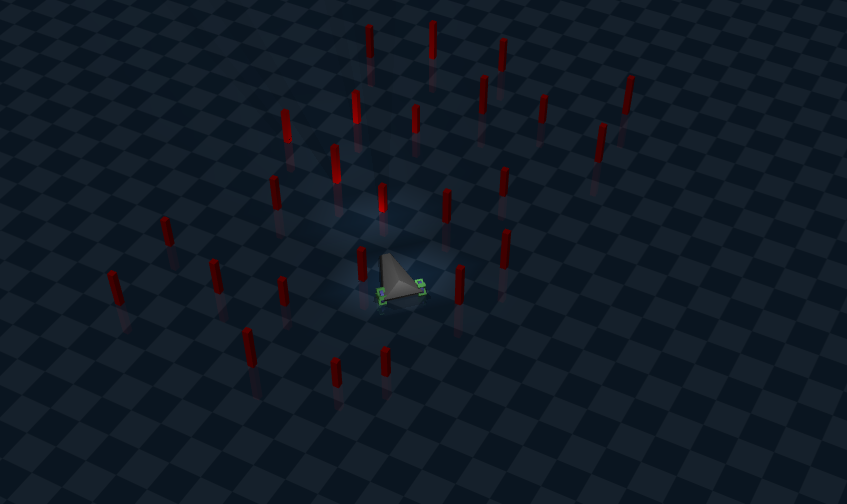
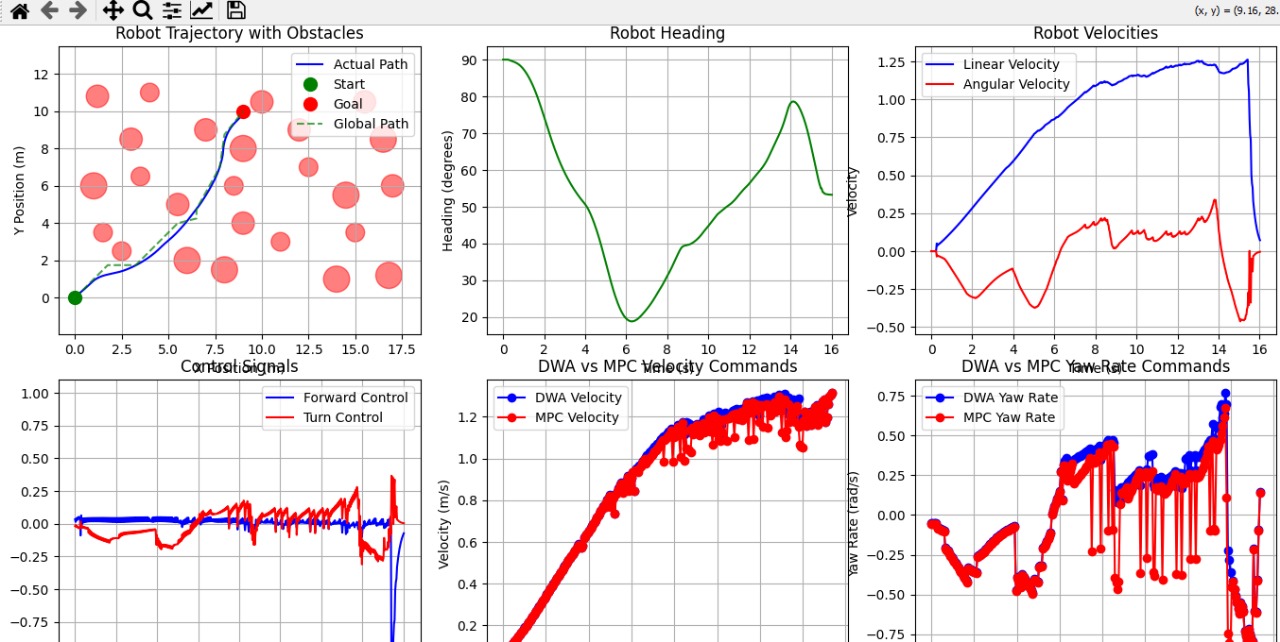
Figure 1 — Left: the MuJoCo environment I built for TriLayer-Nav. Right: one run analysed — the executed trajectory against the A* global path, heading and velocity profiles, and the DWA-versus-MPC command comparison. This is the system from my Gyroscopy and Navigation paper (I am second author). Code: TriNav-Tri-Layer-Navigation-A-DWA-MPC-.
| Project | What I built | Measured result |
|---|---|---|
| 3D perception for autonomous ground vehicles — MSc thesis | I built a training-free pipeline — YOLOv8m-seg → calibrated LiDAR projection → adaptive mask erosion → DBSCAN → PCA oriented 3D boxes — that needs no 3D training data. | KITTI: Car IoU 50.51% · Pedestrian IoU 38.63% · ~11 FPS · 1,874 MiB peak GPU. Code release in preparation. |
| TriLayer-Nav | I co-developed a tri-layer navigation stack: A* → DWA → MPC → PID for differential-drive robots, evaluated in MuJoCo. | Published — Gyroscopy and Navigation, 2026. Against the baseline: position accuracy +27.46%, velocity mean error −52.90%, acceleration tracking error −45.22%. Code |
| AMR obstacle avoidance (ROS 2) | I hand-wrote an A* global planner and a DWA local planner in ROS 2 Humble, with a custom 2D warehouse simulator and moving forklifts (no Nav2, no Gazebo), and documented five failed avoidance strategies in the README. | Final run: 4 moving forklifts, goal reached in 19.4 s with 0 replans and 0 overlaps; benchmark harness across 5 layouts. Code |
| Depth-supervised NeRF | I compared hard, soft, and hybrid depth integration under one controlled protocol on NeRF Synthetic. | Evaluated with PSNR / SSIM / depth error. Code + notebooks |
| YOLO benchmark on KITTI | I benchmarked YOLOv8 / YOLO11 / YOLO12 like-for-like on a 954-image KITTI subset. | mAP@0.5: 75.6 / 74.8 / 73.2 · mAP@0.5:0.95: 48.7 / 50.2 / 49.5 · 42–45 FPS on RTX 4050. Code + results |
| Citation reliability of small LLMs | I verified 850 LLM-generated references against Crossref / OpenAlex across 45 topics. | REAL_OK rate 0.39 on famous topics → 0.03 on niche topics → 0.00 on recent topics. Code |
| Applied LLM systems | I built four working LLM systems in Python with LangChain: validated structured extraction, RAG over PDFs with FAISS, a tool-using agent, and a Streamlit chat app combining the RAG and agent systems, behind a multi-provider fallback chain. | 54 offline tests passing. Code |

Figure 2 — I designed this console from my own benchmark tables: the top half is my pipeline blueprint with the data flow animated; the bottom half plots my measured thesis and YOLO results.
-
Mughal, U. A. B., Ali, A., Urwa, & Abramchuk, M. V. TriLayer-Nav: A Tri-Layer Navigation Framework Integrating A, Dynamic Window Approach, and Model Predictive Control for Differential-Drive Robots* — Gyroscopy and Navigation, 2026, Vol. 17, No. 1, pp. 24–33. Publisher page
-
Improving NeRF Training Quality Using Depth Data: A Comparative Study of Depth-Integration Strategies for 3D Scene Reconstruction — 2026, manuscript under review. Code: depth-supervised-nerf-notebooks
Methods: A* · DWA · MPC · PID · UKF · DBSCAN · PCA · YOLO · NeRF
Tools: Python · PyTorch · OpenCV · Open3D · ROS · MuJoCo · MATLAB · C/C++ · LaTeX