





FPGA/HLS & DSP Engineer | M.S. ECE Candidate | DOA Estimation | Embedded AI | Industrial Hardware Automation
I am an Electrical and Computer Engineering M.S. candidate (expected Dec 2026) at Kennesaw State University. My current work focuses on FPGA/HLS acceleration, DSP/DOA estimation, Embedded AI, and industrial hardware automation.
Since relocating to the United States, I have complemented my academic and research background with hands-on industrial ECE experience. At Wabtec, I support electronics and computer systems, rack-level infrastructure, QA and system validation, Redfish/iLO workflows, Cradlepoint-related automation, and Python/PowerShell-based engineering tools.
- FPGA/HLS acceleration for DSP and radar preprocessing
- Sample Covariance Matrix acceleration for DOA/MIMO radar
- Coarray MUSIC, sparse arrays, mutual coupling, and ALSS regularization
- Embedded AI and ML calibration for sensing systems
- Industrial rack QA automation using Python, PowerShell, Redfish/iLO, and Cradlepoint workflows
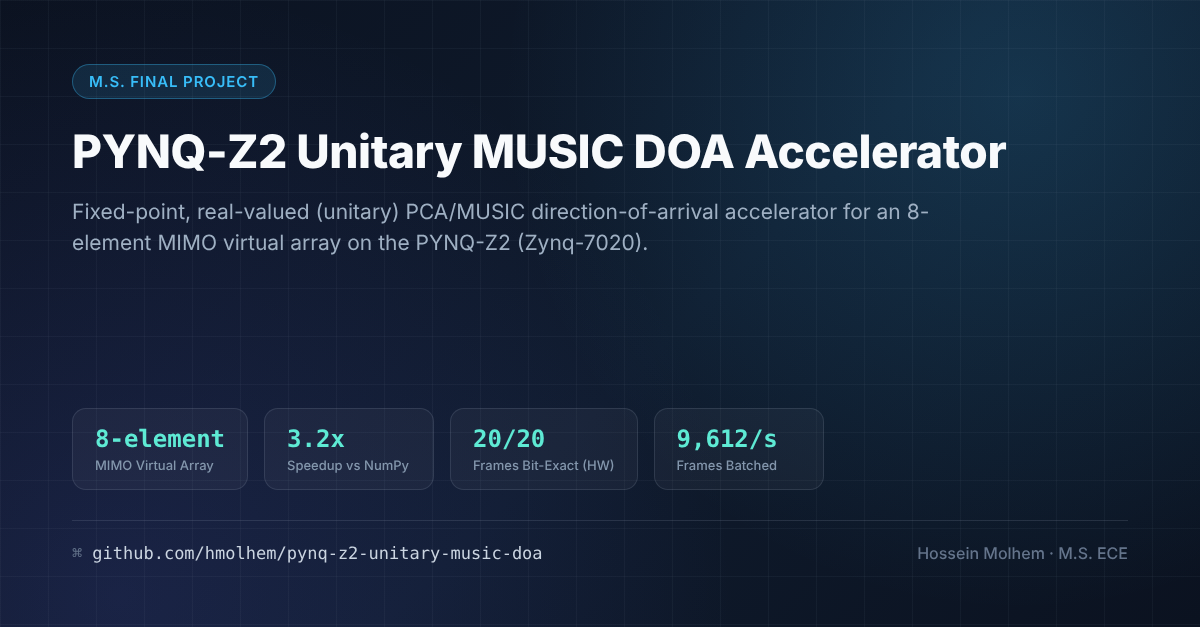
Fixed-point, real-valued (unitary) PCA/MUSIC direction-of-arrival accelerator for an 8-element MIMO virtual array on the PYNQ-Z2 (Zynq-7020): SCM, Jacobi EVD, and MUSIC spectrum in Vitis HLS, with a bit-accurate Python golden model and full on-board validation.
- On-board whole-estimator validation: 20/20 frames bit-exact, 3.2x speedup vs NumPy, 9,612 frames/s batched
- Predecessor covariance-kernel design-space study: fpga-hls-doa-scm-accelerator
Repository: pynq-z2-unitary-music-doa
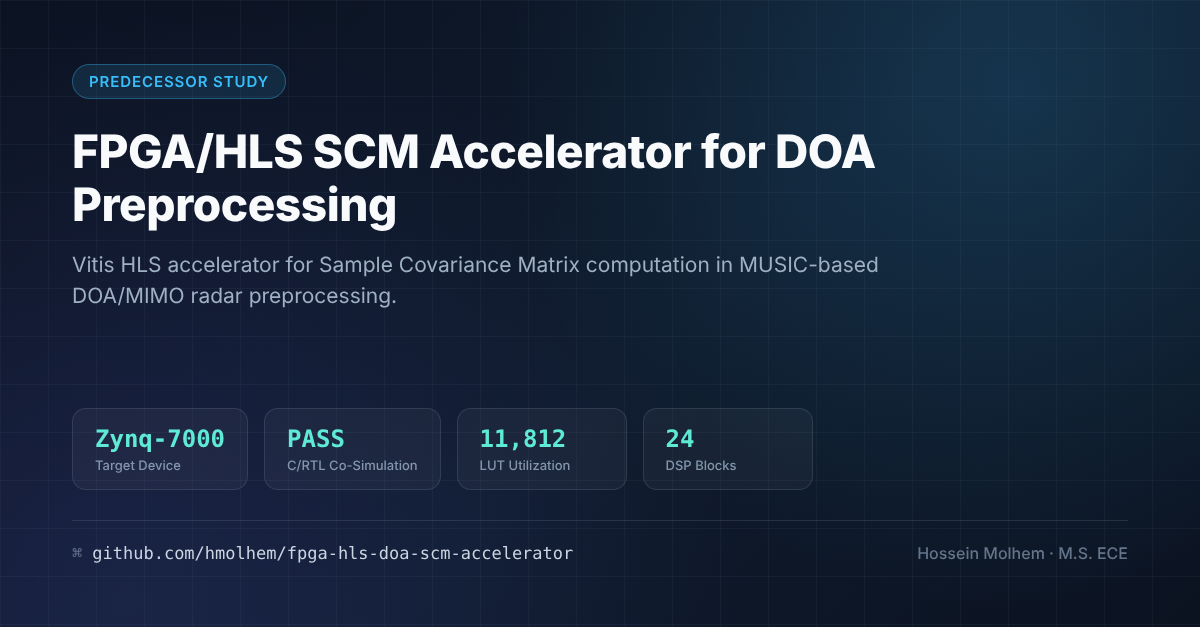
Vitis HLS design-space exploration (D0–D5) for a Sample Covariance Matrix (SCM) accelerator used as DOA preprocessing for an 8-sensor, 128-snapshot uniform linear array. The active design (D5) combines Hermitian-symmetry reduction, full array partitioning, and pipeline interleaving. Predecessor study to the PYNQ-Z2 Unitary MUSIC accelerator above.
- C/RTL co-simulation verified against a software golden model
- D5: 24/220 DSPs (10%), 11,812/53,200 LUTs (22%), latency 1,753–12,673 cycles
Repository: fpga-hls-doa-scm-accelerator
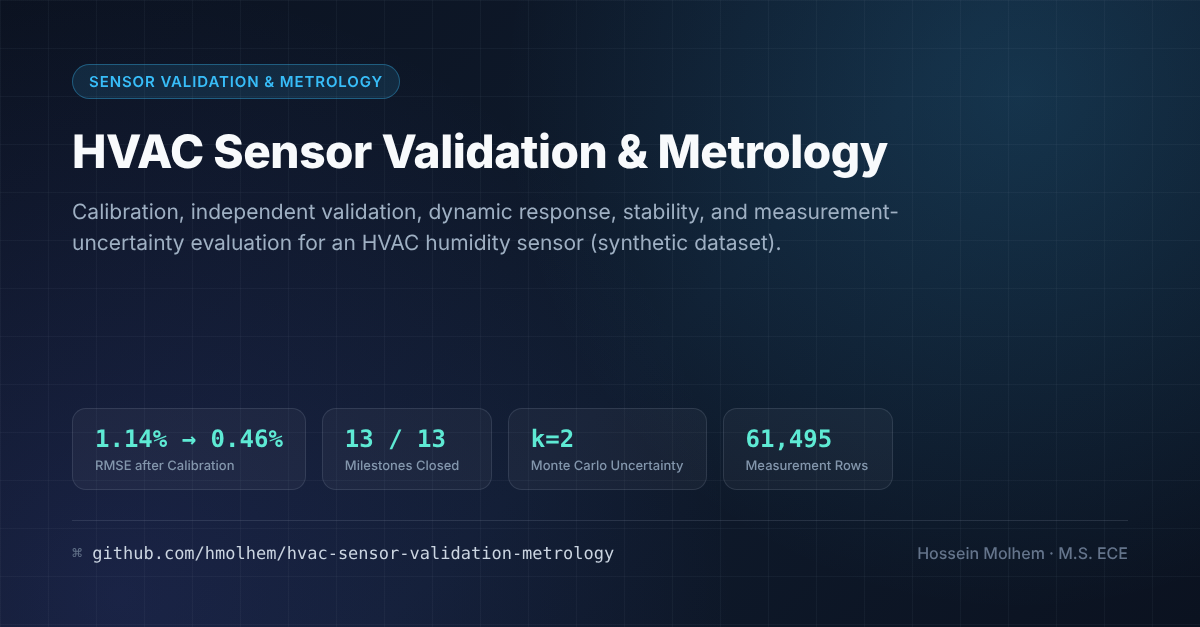
Reproducible engineering case study in sensor characterization, calibration, independent validation, dynamic response, stability, and measurement-uncertainty evaluation for an HVAC relative-humidity sensor, using a physics-informed synthetic metrology dataset (13 milestones, all closed).
- Frozen calibration model reduced independent-validation RMSE from ~1.14 %RH to ~0.46 %RH
- Full measurement-uncertainty budget and Monte Carlo uncertainty analysis
Repository: hvac-sensor-validation-metrology
Physics-informed synthetic-data simulator that generates the controlled measurement campaign (static, step, ramp, cyclic, sinusoidal, and stability test records) used in the HVAC sensor validation study above. All data is simulator-generated, not from real sensor hardware.
Repository: virtual-sensor-metrology-lab
Research-grade Python framework for sparse-array geometry analysis, coarray MUSIC, mutual coupling modeling, and Adaptive Lag-Selective Shrinkage.
Repository: MIMO_GEOMETRY_ANALYSIS
Python/C++ implementation lab for steering vectors, covariance estimation, beamforming, MVDR, MUSIC, and array signal processing algorithms.
Repository: Optimal-Array-Processing
FPGA/HLS: Vitis HLS, Vivado, C/C++ HLS, Verilog, loop pipelining, loop unrolling, array partitioning, C/RTL co-simulation
DSP/Radar: DOA estimation, MUSIC, sample covariance matrix, beamforming, MIMO radar, array processing, electromagnetics
Programming: Python, C/C++, MATLAB, PowerShell, LaTeX, Git/GitHub
Automation/Systems: Redfish/iLO, HPE ProLiant, Cradlepoint/NetCloud, rack-level QA validation, GUI automation
My long-term goal is to build real-time sensing systems from theory to hardware:
Electromagnetics and signal modeling to DSP / DOA algorithms to Python/C++ implementation to FPGA/HLS acceleration to Embedded AI and industrial validation