








I like building AI systems that do more than just make predictions.
I'm pursuing an M.Sc. in Cybernetics & Applied AI at the University of Stavanger, with a bachelor's background in Electronics & Automation.
I started with control systems, embedded electronics, motors and sensors. Somewhere along the way, I became fascinated by how machines learn, reason and make decisions.
These days I spend a lot of time exploring deep learning, LLMs, AI agents and reinforcement learning. My favorite part isn't just getting something to work — it's finding out why it works, where it breaks, and what would make it better.
💬 A little more about how I got here
I used to spend my time tuning controllers and debugging physical systems. Now I also build learning systems — and debug models that can be confidently wrong.
I like projects that force me to go beyond calling an API: implement the underlying methods, question the evaluation, and connect the output to something meaningful.
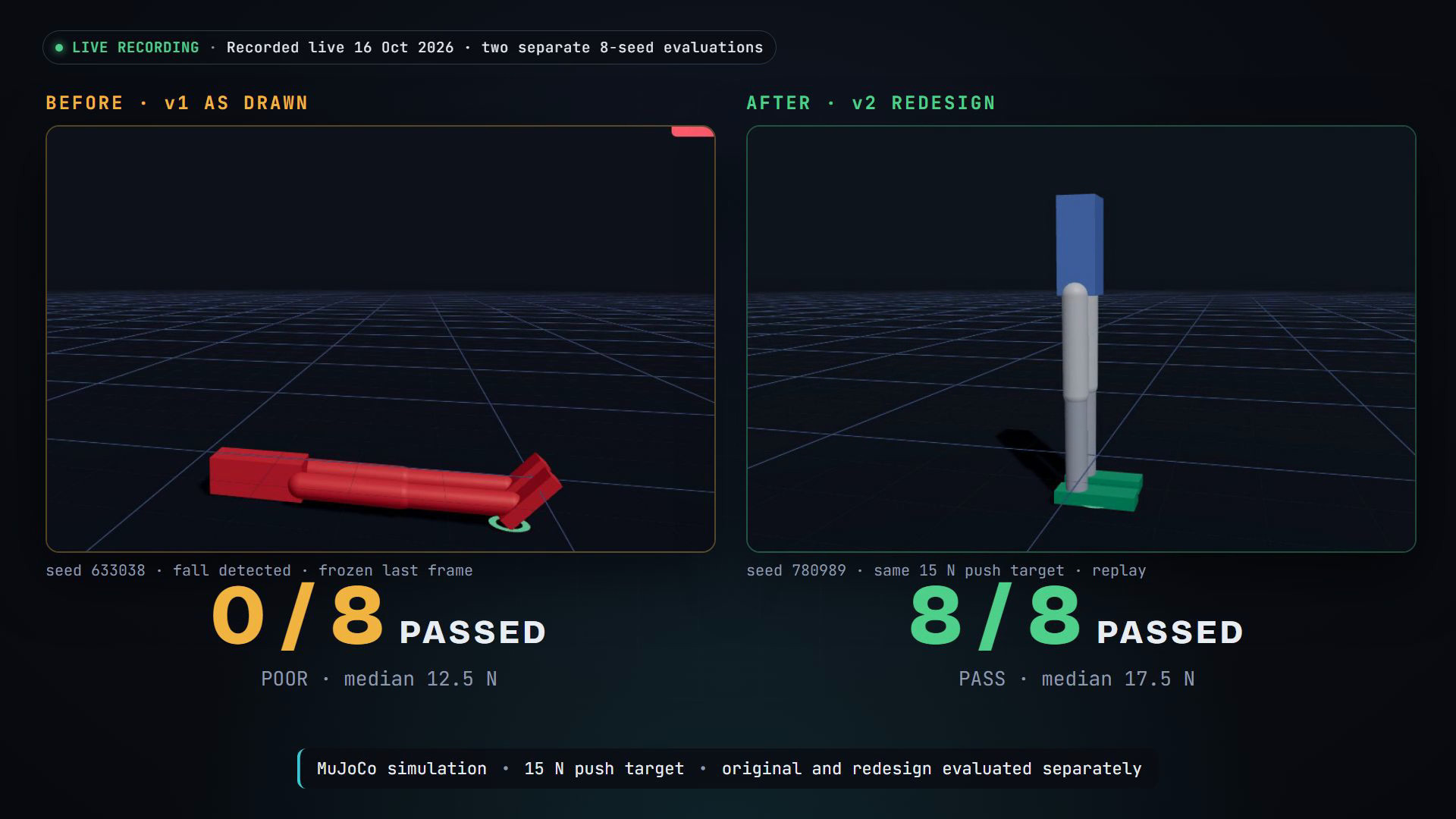
Featured: Creature Forge · Watch the demonstration · Recorded simulation, separate seed panels.
| Project | What made it interesting | |
|---|---|---|
| 🤖 | Creature Forge · Physical AI & LLM agents | Built a MuJoCo robotics lab where NVIDIA Nemotron investigates failures, requests physics experiments and proposes bounded redesigns. Independent simulation verifies changes. In one live demo, an accepted redesign went from 0/8 to 8/8 push tests on separate seed panels. Demo · Evidence. |
| 🎮 | Scaling Deep RL · Soft Actor-Critic · team research | Compared 8 network architectures across 24 one-million-step HalfCheetah-v5 runs (three seeds each), isolating width, depth, normalization and residual connections. Published reproducible analysis and limitations, without claiming a general scaling law. |
| 🔋 | BatterySwapAI 2026 · Predictive maintenance & optimization | Top 5 in a two-person competition team. Modelled stochastic battery degradation using ~8M IoT measurements, then connected failure-risk predictions to scheduling and route optimization. |
| 🧠 | Decoder-Only Transformer LLM · Deep learning fundamentals | Built a character-level Transformer in PyTorch with causal attention, RMSNorm, KV caching, multiple decoding strategies and reproducible evaluations. Tested it against baselines instead of just showing generated samples. |
| 🔎 | FakeTT — Multimodal Misinformation Detection · Multimodal LLMs & evaluation | Led the text-classifier baseline and data-quality audits; worked with teammates on System 2 and developed the selected Prompt C + dynamic five-shot strategy. Fake-news recall rose from 66.7% to 75.0% on a 74-video test split, with precision trade-offs clearly documented. |
| 🎵 | MusicCRS · Conversational AI & recommender systems | Built a music-discovery workspace with catalog-grounded search, listening-context and feedback-aware ranking, and natural-language playlist controls. An optional, bounded LLM planner uses validated Python tools for state changes; preferences are only persisted with explicit approval. Architecture. |
🔎 Pick a rabbit hole — what would you like to explore?
- Can an AI investigate a robot failure and verify a physical redesign? → Creature Forge, demo and evidence
- Does making an RL network larger actually help? → 24 controlled SAC runs
- Can ML predictions improve real operational decisions? → BatterySwapAI's case study
- What's actually inside a language model? → Transformer architecture and implementation
- Can a multimodal LLM detect more misinformation without flagging too much real content? → FakeTT results and ablations
- How can a conversational recommender use an LLM without letting it directly change application state? → MusicCRS architecture
- What happens when a vision system fails outside its training distribution? → Drone Flyby experiments
Projects still in development or not yet released publicly.
🧩 PEIS — An agent that investigates evidence, not just retrieves it
Building a provenance-aware AI system that can search technical evidence, investigate claims across sources, notice contradictions and report when the evidence is insufficient.
Exploring: Agentic reasoning · retrieval · structured memory · evidence verification · context-efficient LLM workflows.
Status: In active development. Public repository to follow.

I care about the full loop. A better metric is only interesting if it survives a meaningful evaluation — and a great model is even more interesting when it helps someone make a better decision.
That mindset comes partly from building physical systems, where the real world doesn't care how convincing a simulation looks.
- Lyse Energi · AI & Data Science Intern: Built an electricity-forecasting and energy-insight proof of concept. Worked with a feature pipeline containing approximately 2.7 billion hourly records, combining ML forecasts with peak, capacity and customer-cost analysis.
- Petoro · AI & Digitalisation Intern: Developed a Python pipeline to turn complex drilling-plan PDFs into structured operational data, using document layout, geometry and image processing.
🛠️ Technologies I keep reaching for
ML & AI: PyTorch, scikit-learn, Transformers, Hugging Face, time-series modelling, information retrieval, LLM tooling.
Data & engineering: Python, NumPy, Pandas, PySpark, Databricks, OpenCV, C/C++, MATLAB/Simulink.
Things I enjoy working on: Agents with verifiable reasoning, deep-learning architectures, reinforcement learning, evaluation that exposes failure modes, and ML for physical systems.
If you're working on an interesting AI/ML problem, have a research idea, or want to compare notes on an experiment that didn't behave as expected, I'd love to hear about it.
📍 Norway · M.Sc. expected 2027 · This page is a work in progress, just like the projects.