

Small · Sortable · Secure ID generator




pikaid is the official Lua implementation of a compact, chronologically sortable, collision-resistant identifier format for databases, APIs, and distributed systems.
This is the immutable, unversioned pikaid format, documented in specification revision 1.0.4.
- Short: Compact, readable IDs for URLs, logs, and API resources.
- Sortable: Lexicographically ordered by timestamp, with one-second precision.
- Collision-resistant: 96 bits of cryptographic randomness make collisions extremely unlikely, never impossible.
- Storage-friendly: Use
BINARY(17)or readableCHAR(26). - Distributed-friendly: No central sequence generator or coordination required.
A pikaid contains 26 lowercase Base36 characters: a 7-character Unix-seconds timestamp followed by 19 characters encoding 96 bits of cryptographic randomness. Its binary form is 17 bytes: 5 unsigned big-endian timestamp bytes followed by 12 randomness bytes.
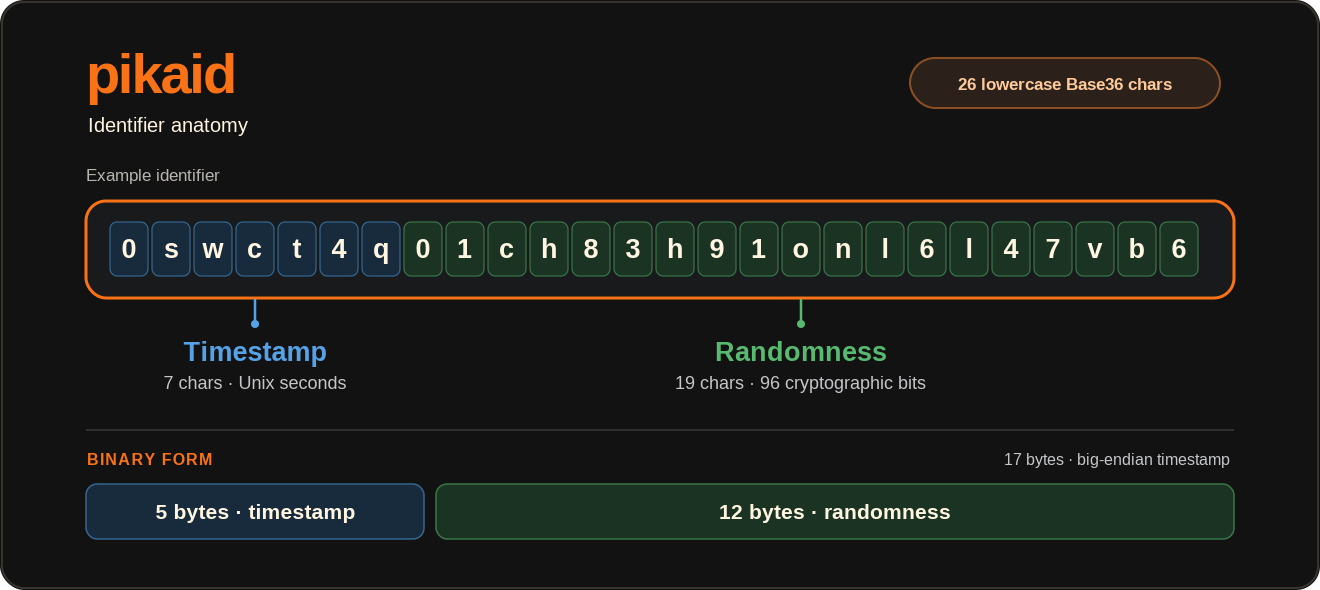
Ordering: Different seconds sort chronologically. Within the same second, randomness—not issuance order—decides the order.
Security: These are identifiers, not secrets, session credentials, authentication tokens, or API keys.
- Lua 5.3, 5.4, or 5.5 from PUC-Rio. The implementation needs the integer subtype, the
//operator, andmath.type. It does not support Lua 5.1, Lua 5.2, or LuaJIT. - A standard 64-bit-integer build. The timestamp range exceeds 32-bit integers, so a
LUA_32BITSinterpreter is rejected when the module loads instead of silently producing corrupt identifiers. - On Linux and macOS, a readable
/dev/urandom. The same device path is used on the BSDs, where it has the same semantics, but CI does not run on BSD. - On other platforms, including Windows, a verified entropy provider passed to
pikaid.new. Generation fails closed rather than falling back to a weaker source.
Install the published release from LuaRocks:
luarocks install pikaidTo test or install from the repository checkout:
git clone https://github.com/pikaid/pikaid-lua.git
cd pikaid-lua
luarocks make pikaid-1.0.0-1.rockspec
Without LuaRocks, put src/ on package.path:
LUA_PATH='./src/?.lua;./src/?/init.lua;;' lua your_script.luaSave the quick start below as demo.lua, then run lua demo.lua after installation.
The LuaRocks publishing workflow validates the
packaging on pushes to main without uploading anything. It also checks the
repository secret LUAROCKS_API_KEY without disclosing it.
To publish a new stable version:
- Change
pikaid.VERSIONinsrc/pikaid/init.luato the next stable semantic version, then commit the change tomain. - Confirm that both CI and Security Hardening succeed for that commit.
- Create and publish a GitHub Release with a new
vX.Y.Ztag pointing to that exact commit.
GitHub Actions generates the matching pikaid-X.Y.Z-1.rockspec from the
reviewed template, verifies the tag, CI, rockspec, and installed package, then
uploads the rockspec and source rock to LuaRocks using the API key. An existing
published version is never overwritten. Do not move or reuse existing tags.
LuaRocks account settings that require interactive two-factor authentication for uploads can prevent unattended publishing; configure an approved non-interactive publishing method before relying on this automation.
local pikaid = require("pikaid")

local id = pikaid.generate()
assert(pikaid.validate(id))
assert(pikaid.is_well_formed(id))
local binary = pikaid.to_binary(id)
assert(#binary == 17)
assert(pikaid.from_binary(binary) == id)
print(id, pikaid.timestamp(id))
The identifier varies on every call; the timestamp is the current Unix second.
Use pikaid to identify users, orders, invoices, uploads, events, and API resources. Independent services can generate compact IDs without a shared counter, while timestamp-based ordering helps with indexing, sorting, and logs.
Specification revisions describe the format; they do not change the encoded identifiers.
| Function | Result |
|---|---|
pikaid.generate([timestamp]) |
26-character identifier |
pikaid.generate_binary([timestamp]) |
17-byte identifier |
pikaid.new([options]) |
instance exposing :generate([timestamp]) and :generate_binary([timestamp]) |
timestamp is optional. When omitted, the current Unix time in whole seconds is used. Supply it only when you already know the correct second.
Because plain Lua exposes no cryptographic random generator, instances are configurable:
local ids = pikaid.new({
  entropy = function(byte_count) return my_verified_csprng(byte_count) end,
  clock = function() return my_clock_seconds() end,
})
An entropy provider must return exactly 12 bytes; anything else fails closed with entropy_unavailable. A clock must return an integer number of seconds inside the supported range.
| Function | Result |
|---|---|
pikaid.validate(value) |
true only for a fully valid string |
pikaid.is_well_formed(value) |
true when the value has the 26-character lowercase Base36 shape |
pikaid.validate_binary(value) |
true only for a fully valid 17-byte value |
is_well_formed is a shape check, not a validity check: a string can have the right shape while its randomness exceeds 96 bits, in which case validate is false.
| Function | Result |
|---|---|
pikaid.parse(value) |
{ timestamp, randomness, randomness_hex } or raises |
pikaid.try_parse(value) |
the same table, or nil, error_object |
pikaid.parse_binary(value) |
parsed fields from a binary value, or raises |
pikaid.try_parse_binary(value) |
the same table, or nil, error_object |
pikaid.to_binary(value) |
17-byte binary form |
pikaid.from_binary(value) |
canonical 26-character form |
pikaid.timestamp(value) |
integer Unix seconds |
pikaid.randomness(value) |
12 raw bytes |
| Function | Result |
|---|---|
pikaid.compare(left, right) |
-1, 0, or 1 by unsigned byte order |
pikaid.is_error(value) |
true for a pikaid error object |
Functions without a try_ prefix raise on invalid input. The raised value is a table with code and message fields and a __tostring metamethod that renders as pikaid: <code>: <message>; error is called with level 0, so the object arrives unchanged.
Error codes:
| Code | Meaning |
|---|---|
invalid_type |
operand is not a string, or an option has the wrong type |
invalid_length |
wrong number of characters or bytes |
invalid_character |
a character outside 0-9a-z |
invalid_timestamp |
timestamp supplied or returned by a clock is not an integer |
timestamp_out_of_range |
timestamp outside 0 .. 78364164095 |
randomness_out_of_range |
randomness is at least 2^96 |
entropy_unavailable |
the entropy provider failed or returned the wrong length |
clock_unavailable |
the clock raised |
| Constant | Value |
|---|---|
pikaid.VERSION |
"1.0.0" |
pikaid.STRING_LENGTH |
26 |
pikaid.BINARY_LENGTH |
17 |
pikaid.TIMESTAMP_DIGITS |
7 |
pikaid.RANDOMNESS_DIGITS |
19 |
pikaid.ENTROPY_BYTES |
12 |
pikaid.MAX_TIMESTAMP |
78364164095 (36^7 - 1, 4453-04-05T15:21:35Z) |
pikaid.VERSION is the library version; the identifier format itself is unversioned.
Valid identifiers with different timestamps sort chronologically in both forms, because the timestamp occupies the most significant digits and the most significant bytes.
Two identifiers created within the same second have a random relative order. Generation within a second is not monotonic, and pikaid does not promise that a later call returns a greater identifier.
pikaid.compare compares raw unsigned bytes and is independent of the process locale. Lua's < operator is not: it follows the collation set by os.setlocale, so sorting pikaid values with < in a non-ASCII locale such as Turkish can reorder them. Use pikaid.compare, or store the binary form in a BINARY/BLOB column.
When storing text identifiers in a database, use an ASCII-compatible collation. A case-insensitive or language-aware collation can change the ordering of the Base36 alphabet.
| Representation | Size | Recommended for |
|---|---|---|
| BINARY(17) | 17 bytes | Compact primary keys and indexes |
| CHAR(26) | 26 characters | Readable SQL, debugging, URLs, and logs |
Use an ASCII bytewise/binary collation for text columns (for example, ascii_bin on MariaDB/MySQL). Case-insensitive or locale-aware sorting is not a substitute for canonical bytewise comparison.
The CI workflow runs native tests, pinned automated conformance checks, and language-specific quality gates. To run the native checks locally from a checkout, use lua spec/run.lua.
Automated passing tests are not a security certification. The independent CSPRNG source and failure-path audits (P-GENERATE-RNG-SOURCE and P-GENERATE-RNG-FAILURE) still require separate human evidence.
Platform, tooling, and conformance details
| Platform | Default entropy source | Notes |
|---|---|---|
| Linux | /dev/urandom |
supported; exercised by CI |
| macOS | /dev/urandom |
supported; exercised by CI |
| BSD | /dev/urandom |
expected to work by the same device contract; not exercised by CI |
| Windows | none | supply options.entropy; generation fails closed otherwise; not exercised by CI |
Run the conformance suite:
lua spec/run.luaLint and coverage:
luacheck src spec
eval "$(luarocks path)"
LUA_PATH="./src/?.lua;./src/?/init.lua;${LUA_PATH:-}" lua -lluacov spec/run.lua && luacov
The suite is dependency-free and runs on every supported Lua version. It covers:
- every case in the official
pikaid-v1.jsonfixture set, unmodified, with its SHA-256 digest pinned; - the official JSON Schema's constraints, as executable assertions;
- 290 cases from an independent Python arbitrary-precision oracle (
spec/fixtures/reference-cases.json, generated byspec/tools/generate_reference_cases.py), for parsing, conversion, and generation; - hand-derived known answers for the Base36 anchors and both overflow boundaries;
- strict rejection of wrong types, lengths, characters (including CR, LF, CRLF, and multi-byte zero-width characters), and out-of-range fields;
- lossless round-trips over deterministic property cases;
- entropy-provider and clock failure modes, including the guarantee that
math.randomis never consulted; - locale-independent comparison under a non-ASCII collation when the platform provides one;
- the documented README quick start, run against both a checkout and an installed package.
spec/tools/jsonl_adapter.lua is a test-only JSON-Lines bridge that the shared
pikaid-specs runner drives. It contains no codec, validator, or generator of
its own: every semantic operation is delegated to the real public pikaid
module, and it advertises only capabilities that a public function backs.
repo="$PWD"
spec_sha=059780cc0e5b113443812720d95c630649bf3aa3
spec_dir="${TMPDIR:-/tmp}/pikaid-specs"
rm -rf "$spec_dir"
git clone https://github.com/pikaid/pikaid-specs.git "$spec_dir"
git -C "$spec_dir" checkout "$spec_sha"
python3 -m pip install jsonschema==4.26.0
(cd "$spec_dir/conformance" && \
  python3 tools/run_adapter.py --automated-only -- \
    lua "$repo/spec/tools/jsonl_adapter.lua")
--automated-only exits 0 only when every automated check passes. It still
leaves the suite's manual security audits outstanding, so it is not a
conformance certification.
Continuous integration runs the same suite on Linux and macOS against Lua 5.3, 5.4, and 5.5. A separate job checks out the official pikaid-specs suite at the pinned commit above, verifies its fixture digests, runs its verifier tests and independent Node oracle, and drives the JSONL adapter with --automated-only. Further jobs run luacheck, regenerate the independent oracle and fail on any diff, enforce a line-coverage gate, build a LUA_32BITS interpreter and assert that pikaid refuses to load on it, lint and install the rockspec, and check that the source archive excludes local artifacts. All workflows use read-only repository permissions.
The Windows and BSD default entropy paths are not exercised by CI: Windows has no /dev/urandom, so Windows callers must inject a verified provider, while BSD is expected to work through the same /dev/urandom contract as Linux and macOS. The generation logic itself is platform-independent, and a missing or failing provider always raises instead of degrading.
- RELEASING.md — non-destructive tag, build and publish runbook.
docs/csprng-review-packet.md— file/line map for the two manual CSPRNG audits (P-GENERATE-RNG-SOURCE,P-GENERATE-RNG-FAILURE). Automated conformance does not substitute for the independent human review.
spec/vectors/pikaid-v1.json and spec/vectors/pikaid-v1.schema.json are copied unmodified from the pikaid-php v1.2.0 release at commit e3f843edeb5157a5d2d25196cac0d69580810a95; their provenance and hashes are recorded in spec/vectors/README.md. They implement the rules of pikaid specification revision 1.0.4 (commit 17014d76f568c3ac9f9ce2927c1a018fdbc36d1d), which remains the normative source. The PHP fixtures are interoperability data, not the normative definition.
Registry publication is not implied by a green CI: use the installation method documented above.
Contributions are always welcome! 💙
Whether you're fixing a typo, improving documentation, adding tests, or making pikaid even better, every contribution is appreciated.
Want to help? Here's how:
- 🐛 Found a bug? Open an issue with clear reproduction steps.
- 💡 Have an idea? Start with an issue before making major changes.
- 🛠️ Ready to contribute? Open a pull request explaining your changes.
- 🧪 Keep it tested. Add meaningful regression tests for behavior changes and follow the existing conventions.
- ✅ Make sure CI passes. All required checks must be green before a pull request is merged. No shortcuts!
One important rule: pikaid's identifier format is immutable. Contributions must preserve the canonical specification (revision 1.0.4).
🔐 Found a security vulnerability? Report it privately using GitHub's security reporting (when available), or contact the maintainer—not through a public issue.
Every improvement matters, big or small. Thanks for helping make pikaid better! 🐇
The implementation is available under the MIT License.
For licensing or project-related questions: larananas.dev@proton.me.