English | 简体中文 | 日本語 | 한국어 | Русский




A tiny, secure, and human-friendly ID generator for JavaScript.
- Tiny 506 bytes for
tidyid()(minified and Brotli-compressed). Zero runtime dependencies. - Secure Uses the platform CSPRNG with unbiased sampling and no weak fallback. Generate independently across threads, processes, and cluster nodes; enforce absolute uniqueness with a database constraint.
- Human-friendly Creates letter-first, lowercase-alphanumeric IDs by default with a fixed
LLDrhythm—no accidental long words, punctuation, or ambiguous characters. Easy to read, type, and transcribe; ready for URLs, filenames, database/cache/object-storage keys, DOM/CSS IDs, command lines, logs, and more.
import { tidyid } from 'tidyid'

const id1 = tidyid(32)       // ag8dw2tx7qx6qw4ck2mf4cc3xb8gd9vc (length = 32)
const id2 = tidyid(16)       // mh4dx8tq3bd2rz7h (length = 16)
const id3 = tidyid(10)       // td7et3cv6w (length = 10)
const id4 = tidyid(10, true) // rN9gK6cM2w (length = 10, allowUppercase = true)
Explicitly passing the length in application code is strongly recommended, even when using the default of 32.
npm i tidyidor
pnpm add tidyidInstall TidyID globally:
npm i -g tidyidThen generate an ID:
tidyid
# wq3cc5gt9gj8nc7kh4fq2mq3yf6gk2wx (length = 32)

tidyid -s 16
# bq7th2vj6xn4zk9b (length = 16)

tidyid -s 10 -u
# Av2Mr4Aw3Y (length = 10, allowUppercase = true)
Use --size or -s to set the length. Use --allow-uppercase or -u
to allow uppercase letters.
By default, IDs repeat two lowercase letters followed by one digit (LLD):
xr3 fc9 xy2
| Characters | Positions | Alphabet |
|---|---|---|
| Letters | First two of each group | abcdefghjkmnpqrtuvwxyz |
| Digits | Every third character | 23456789 |
- Every ID starts with a letter.
i,l,o,s,0, and1are excluded to reduce visual and handwritten ambiguity.- The pattern prevents long letter sequences and needs no escaping in URL paths, filenames, or HTML/CSS IDs.
- In default mode, typing needs no Shift key,
_,-, or other punctuation.
allowUppercase defaults to false. Set it to true to sample letter
positions from the combined uppercase and lowercase alphabet.
| API | Description |
|---|---|
tidyid(length = 32, allowUppercase = false) |
Generate a 3–256 character ID; defaults to 32. |
isValidId(value, length?, allowUppercase = false) |
Check format and optional exact length. |
ensureValidId(value, length?, allowUppercase = false) |
Throw InvalidIdLengthError or InvalidIdFormatError. |
getIdCapacity(length = 32, allowUppercase = false) |
Return the exact ID space as bigint. |
getIdEntropy(length = 32, allowUppercase = false) |
Return entropy in bits. |
Constants: LETTERS, LETTERS_WITH_UPPERCASE, DIGITS, DEFAULT_LENGTH, MIN_LENGTH, MAX_LENGTH.
Errors: InvalidIdLengthError, InvalidIdFormatError.
-
Unpredictability Node.js uses
node:crypto.randomFillSync; browsers usecrypto.getRandomValues. Both use the platform cryptographically secure random number generator, neverMath.random(). -
Uniformity Letter positions use rejection sampling, while digit positions use an exact eight-way mapping. Both avoid modulo bias, so every valid ID of the same length and mode has equal probability.
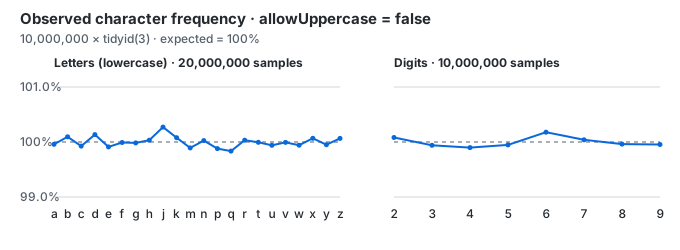
Default mode (
allowUppercase = false): observed frequencies from 10,000,000 generated 3-character IDs stay close to the expected uniform distribution.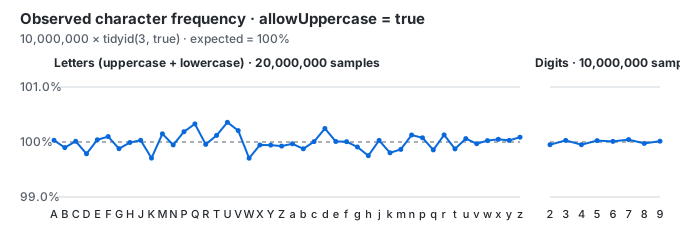
Uppercase-enabled mode (
allowUppercase = true): observed letter and digit frequencies from 10,000,000 generated 3-character IDs stay close to the expected uniform distribution. -
Fail closed Random-source failures are propagated. TidyID never falls back to predictable randomness.
-
Collision-aware Choose a length for your scale to make collisions extremely unlikely. Use a database
PRIMARY KEYorUNIQUEconstraint when absolute uniqueness must be enforced.Default mode (
allowUppercase = false)Length Capacity Entropy 8 7,256,313,856 32.76 bits 10 1,277,111,238,656 40.22 bits 12 224,771,578,003,456 47.68 bits 16 19,146,942,100,646,395,904 64.05 bits 23 6,315,282,784,770,463,143,393,492,992 92.35 bits 32 366,605,391,805,505,419,895,548,144,464,707,977,216 128.11 bits Uppercase allowed (
allowUppercase = true)Length Capacity Entropy 8 464,404,086,784 38.76 bits 10 163,470,238,547,968 47.22 bits 12 57,541,523,968,884,736 55.68 bits 16 39,212,937,422,123,818,811,392 75.05 bits 23 413,878,372,582,717,072,565,435,956,723,712 108.35 bits 32 1,537,654,461,271,398,604,689,577,164,520,902,527,668,977,664 150.11 bits Use 16 or more characters for large public datasets. For security tokens, choose the length based on your threat model. A 32-character TidyID provides 128.11 bits of entropy by default, or 150.11 bits with
allowUppercase = true.
Use a primary key or unique constraint. Insert first and retry only an ID conflict—never query before inserting:
for (let attempt = 0; attempt < 128; attempt += 1) {
  const id = tidyid(16)
  const { rowCount } = await db.query(
    `INSERT INTO resources (id) VALUES ($1)
     ON CONFLICT (id) DO NOTHING RETURNING id`,
    [id],
  )
  if (rowCount === 1) return id
}
throw new Error('unable to insert a resource with a unique TidyID')
Propagate network, permission, transaction, and non-ID constraint errors.
- Node.js
>=22.12 - Modern browsers with Web Crypto and
TextDecoder - Condition-aware bundlers select the browser entry automatically
MIT