
An Alexa+ agent that runs an elderly parent's day at home, so the working caregiver gets her evenings back.


Built for the Build, Ship, Shape: Amazon Developer Hackathon (Alexa+ track). All code was written during the submission period.
People who care for an aging parent while holding a job spend their evenings on logistics: pills, meals, water, the bathroom, checking in. Smart pill boxes, reminder apps and fall alarms exist, but each works alone, and every one of them is built to watch the parent.
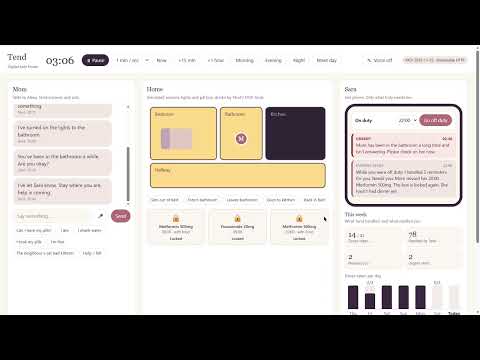
Tend connects every signal in the home and acts on them together. It keeps the pill box locked until she has eaten, expects a bathroom trip after a water pill, lights the way at night, and checks in before it alarms anyone. The caregiver taps Off duty, and Tend handles the routine silently, holds what can wait, and breaks through only for a real emergency.
The result is a parent who never has to wait for help, and a caregiver whose phone stays quiet unless it matters.
Tend is not a medical device. The care plan is the source of truth. Tend never changes a dose; it only sequences around rules the caregiver sets.
For the parent (voice-first, through Alexa+)
- Pills at the right time, not before. Each compartment unlocks only in its time window. Outside it, the box stays locked and Tend says when it opens next.
- Food-first doses. A pill marked "with food" is held until a meal is confirmed, then unlocks on its own.
- Cross-signal reminders. A water pill triggers a bathroom reminder 40 minutes later. Water reminders taper off in the evening so sleep isn't broken.
- Night light path. Getting out of bed at night lights the bedroom, hallway and bathroom, and turns them off when she is back in bed.
- Check in before alarming. Unopened pills, a long bathroom visit or a silent morning lead to a gentle voice check-in first.
For the caregiver
- Off duty mode. Routine events are handled silently, non-urgent problems are held, urgent ones always get through.
- Missed-dose alert. An offered dose that isn't taken relocks the box and is reported.
- One recap, not a list of chores. When off duty ends: what she ate and took, what still needs attention, and one nice moment from her day.
- A week at a glance. Doses taken, what Tend handled itself, what needed her and how many urgent alerts, with a bar per day.
- Urgent words never wait. "Help", "I fell" or "chest pain" alert the caregiver immediately, off duty or not.
For developers
- A real MCP server with 15 tools over Streamable HTTP (spec 2025-11-25).
- A deterministic rules engine, with every rule covered by tests. No LLM in the safety path.
- A digital twin home that makes every MCP call visible as it happens.
| Layer | Technology |
|---|---|
| Agent protocol | Model Context Protocol, spec 2025-11-25, Streamable HTTP |
| MCP server | Python, official MCP Python SDK (mcp>=1.30,<2) |
| Rules engine | Pure Python, dataclasses, simulated clock |
| Twin backend (MCP client) | Starlette + Uvicorn |
| Twin front end | HTML, CSS, vanilla JavaScript, inline SVG |
| Voice | Web Speech API (speech recognition + synthesis) |
| Tests | pytest (44 tests) |
Morning: pills are due, but she hasn't eaten. The box stays locked.

She says "I ate". The compartment unlocks on its own.

Evening: the caregiver was off duty. She gets one recap.

Night: lights guide her to the bathroom. No reply to the check-in, so the alert breaks through.

Demo video (under 3 minutes): https://youtu.be/iJUlLaYF9cc
flowchart TD
    A["Parent's Alexa+<br/>voice in, voice out"] -->|what she says| B
    H["Digital twin home<br/>pill box, lights, sensors"] -->|events| B
    P["Caregiver's phone<br/>alerts, off duty, recap"] <-->|alerts and off duty| B
    B["Twin backend<br/>MCP client"] <-->|MCP 2025-11-25, Streamable HTTP| S["Tend MCP server<br/>15 tools"]
    S --> E["Rules engine<br/>14 tested rules"]
    E <--> C["Care plan + home state<br/>care_plan.json"]
Every button press and every sentence in the twin becomes a real MCP tool call. The server passes it to the rules engine, which reads the care plan and the home state and returns one decision: unlock, keep locked, remind, light, or escalate.
Because Alexa+ speaks MCP, the same server can drive real Alexa-compatible devices in place of the simulated ones.
Tend uses no cameras. In the twin, buttons stand in for sensors; in a real home the same signals come from small Alexa-compatible devices. Motion and door sensors tell Tend which room she is in and for how long, without recording anyone in her bedroom or bathroom.
| In the twin | In a real home |
|---|---|
| "Gets out of bed" / "Back in bed" | Bed pressure pad or bedroom motion sensor |
| "Enters / Leaves bathroom" | Motion sensor plus a door contact sensor |
| "Goes to kitchen" | Motion sensor |
| Pill box compartments | Smart pill dispenser with a lock and a lid sensor |
| Rooms lighting up | Smart bulbs or smart plugs |
| Caregiver's phone panel | Phone notifications (see Future Improvements) |
The MCP tools stay the same; only the source of the events changes.
| # | Situation | What Tend does | Severity |
|---|---|---|---|
| 1 | Dose is due, no food rule | Unlocks that compartment only | Routine |
| 2 | Dose is due, "with food", no meal yet | Keeps it locked, unlocks when she has eaten | Routine |
| 3 | Pills requested outside any window | Stays locked, says when it opens next | Routine |
| 4 | Unlocked but not opened in 20 min | Voice check-in, then tells the caregiver | Escalate |
| 5 | Diuretic taken | Bathroom reminder 40 min later | Routine |
| 6 | 2 hours without water (day) | Water reminder; fewer in the evening, none at night | Routine |
| 7 | Mealtime passed, no meal | One meal reminder | Routine |
| 8 | Out of bed at night | Lights a path to the bathroom | Routine |
| 9 | In the bathroom over 25 min | Voice check-in, then an urgent alert | Urgent |
| 10 | No sign of activity in the morning | Voice check-in, then an urgent alert | Urgent |
| 11 | "Help", "I fell", "chest pain" | Urgent alert at once | Urgent |
| 12 | Caregiver off duty | Routine silent, escalations held, urgent breaks through | Mode |
| 13 | Off duty ends | One recap | Recap |
| 14 | Offered dose not taken in its window | Relocks the box, tells the caregiver | Escalate |
Every timing lives in care_plan.json, not in code.
Requires Python 3.11 or newer. Tested on Windows 11 with Python 3.14.
git clone https://github.com/fsafva13-coder/tend.git
cd tend
python -m venv .venv
.venv\Scripts\activate          # macOS/Linux: source .venv/bin/activate
python -m pip install -r requirements.txt
Check that everything works:
python -m pytest -v # 44 passedOne command starts everything:
python run.pyThis starts the MCP server and the digital twin, opens http://127.0.0.1:8080 in your browser, and stops both when you press Ctrl+C. On Windows you can also double-click start.bat.
Prefer to run the two programs separately?
Use two terminals, both with the virtual environment activated.
python server.py                # Terminal 1: MCP server at http://127.0.0.1:8000/mcp
python twin/app.py              # Terminal 2: twin at http://127.0.0.1:8080
Open the page in Chrome or Edge (needed for voice).
- Press Play. At 08:00 Tend offers the morning pills but holds them: she must eat first.
- Say or tap I ate. Compartment 1 unlocks. Tap it to take the pills.
- Evening → Go off duty → The neighbour's cat had kittens! → +1 hour → I ate → tap the compartment → +1 hour. The caregiver gets one calm recap.
- Reset day and repeat step 3 without eating. The dose is missed, the box relocks, and the caregiver is told.
- Night → Gets out of bed → Enters bathroom → +15 min twice. The lights come on, Tend checks in, and the urgent alert breaks through.
npx @modelcontextprotocol/inspectorConnect with Streamable HTTP to http://127.0.0.1:8000/mcp.
| Tool | Purpose |
|---|---|
get_home_state |
Clock, pill box, lights, caregiver inbox |
request_pills |
Parent asks for her pills |
log_meal, log_water |
Record a meal or a drink |
mark_taken |
Pills removed from a compartment |
motion |
Bed and bathroom sensor events |
heard |
Anything the parent says; urgent words alert at once |
patient_replied |
Answer to a check-in |
note_moment |
Save a nice moment for the recap |
start_off_duty |
Caregiver goes off duty until a time |
get_caregiver_inbox |
Alerts, recaps and held items |
get_week_summary |
The caregiver's week: doses, handled by Tend, needed her, urgent |
advance_time, set_time, reset_day |
Demo clock controls |
tend/
├── run.py                     # One command: starts everything, opens the page
├── start.bat                  # Windows: double-click to start
├── server.py                  # MCP server: 15 tools over Streamable HTTP
├── care_plan.json             # Medications, meal times and every threshold
├── tend/
│   └── engine.py              # Rules engine, home state, simulated clock
├── twin/
│   ├── app.py                 # Twin backend: an MCP client + intent parser
│   └── index.html             # Digital twin home (floor plan, pill box, phone)
├── tests/
│   ├── test_pillbox.py        # Rules 1-3
│   ├── test_daily_rules.py    # Rules 4-8
│   └── test_safety_and_off_duty.py   # Rules 9-14, recap, day rollover
├── docs/screenshots/
├── FRICTION_LOG.md            # Developer-experience notes for the hackathon
├── requirements.txt
└── LICENSE
| Measure | Value |
|---|---|
| Rules implemented | 14 |
| Automated tests | 44, all passing |
| MCP tools | 15 |
| MCP protocol negotiated | 2025-11-25 over Streamable HTTP |
| External services required | None; runs fully on one laptop |
| Cost to run | Zero |
The week view on the caregiver's side counts these as they happen. Its earlier days are sample data (marked as such in the app and in the tool's output); only today's column is live.
In the walkthrough above, a calm evening produces one notification for the caregiver (the recap) while Tend handles the reminders itself. Urgent words reach her at once, even when she is off duty.
- Overlapping dose windows. At exactly 09:00 the 08:00 window and the 09:00 window are both open. Tend offers one dose at a time and holds the later one until the earlier is resolved, which is the safe order.
- A recap that sounded fine when it wasn't. An early version said "a quiet evening" while dinner and a dose were still outstanding. The recap now lists anything still open under "Needs you" before it says anything reassuring.
- Silent missed doses. At first the box only opened when asked, so a dose nobody requested simply vanished. Tend now offers each dose at its time and reports any that are missed.
- Time jumps in a demo. Skipping the clock forward produced stale reminders ("have you had lunch?" at 19:00). Reminders now expire, and a dose is only reported as missed if Tend actually offered it.
- MCP SDK versions.
pip install mcpinstalls 2.x, whereFastMCPwas renamed and a newer protocol is negotiated. Pinningmcp>=1.30,<2gives exactly spec 2025-11-25. SeeFRICTION_LOG.md. - "Ate" versus "eight". Browser speech recognition returned "8" for "I ate". The twin now reads several recognition candidates and picks the one that makes sense.
- Replace the keyword intent parser with an LLM, keeping the rules engine as the only decision-maker.
- Smarter urgent-word detection: "that was helpful" currently matches "help". A false alarm is the safer failure, but it should be rare.
- Real devices: Alexa-compatible smart lock pill dispenser, lights and motion sensors in place of the simulation.
- Deliver caregiver alerts to a real phone: Alexa app notifications first, text messages for urgent alerts, then a small companion app with the Off duty button and recap.
- Build the week view from stored history. Today's column is live; the six earlier days are sample data seeded for the demo.
- Several caregivers with a handover between them.
- Caregiver-editable care plan in the app instead of a JSON file.
- Video: https://youtu.be/iJUlLaYF9cc
- Run it yourself: follow Installation and Usage; it takes about two minutes.
MIT. See LICENSE.
Built by Fathima Safva.